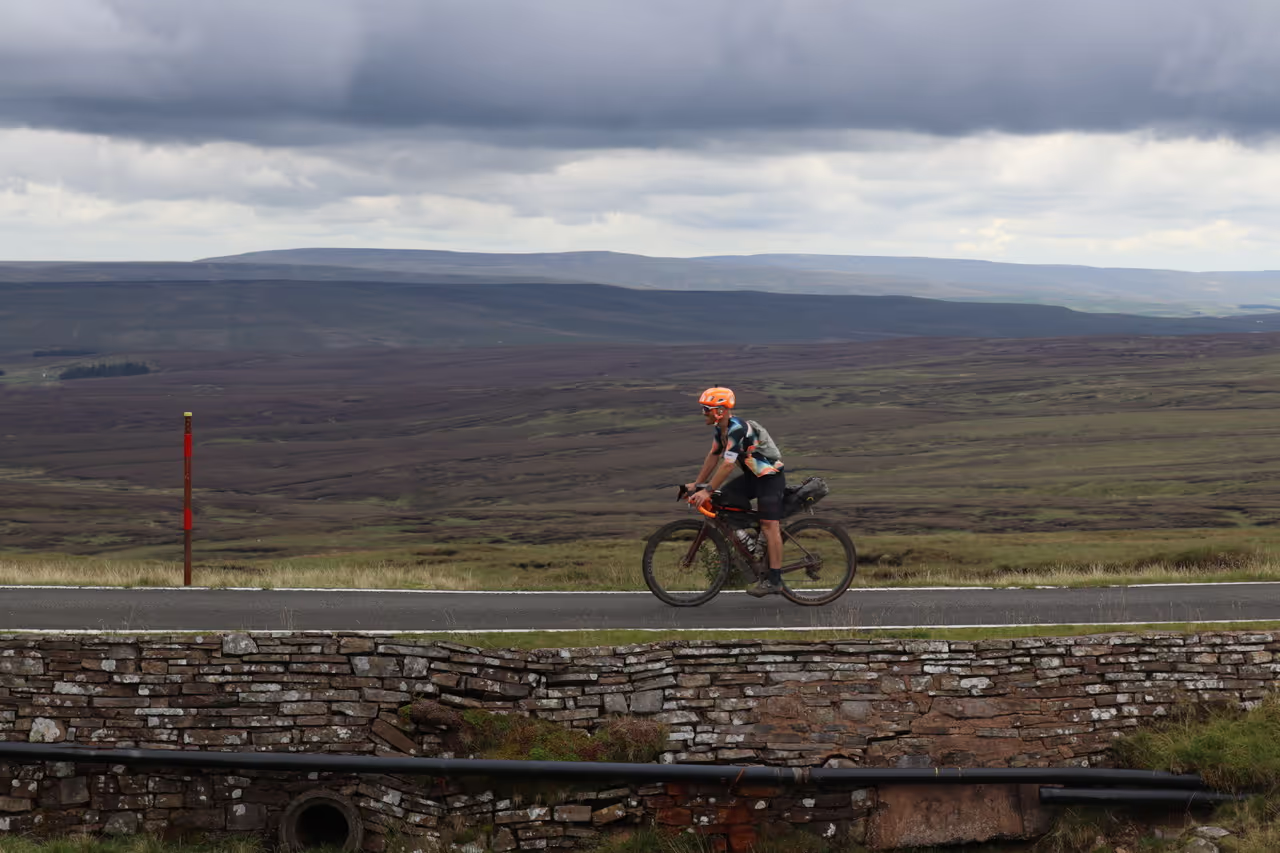
Donnie Campbell: “The joy is in the doing”
There’s a certain type of person who looks at a long line across a map and sees possibility. Not just a route, but a journey. A chance to learn something. To test the edges. To come home feeling quietly changed.
Donnie Campbell is one of those people.
You might know him best as an ultra runner. He’d be the first to tell you that label is too neat. “I often introduce myself as an injured runner when doing talks,” he laughs. “I’d describe myself as an endurance athlete.”
That identity has always stretched beyond one discipline. Even when he raced ultra marathons competitively, winters often meant skis, skimo races in Scotland, and big days out ski touring. The thread running through it all is simple: movement, effort, curiosity, and an appetite for adventure.
And now, that same mindset is bringing him to The Gralloch Ultra.
From not owning a bike to chasing big days
Donnie didn’t grow up as a cyclist. In fact, he didn’t own a bike until 2020.
He bought one for a reason that makes perfect sense if you know his flavour of endurance: he needed it for a major challenge. He’d chosen a gravel bike because it felt like the most versatile tool for the job, and something he would keep using afterwards.
A few weeks later, he learned the first hard lesson of gravel the way many of us do: at speed, on a corner, with a split-second decision.
“The bike started to slide so I straightened up and went into a ditch,” he says. “I hit a cut-down tree trunk and went over the handlebars.”
It left him with a fractured rib. Not ideal. Also not the end of the story.
In the following year, another familiar chapter arrived for Donnie. Injury. A flare-up. A forced pivot.
A back injury that had surfaced before returned, leaving him unable to run for months. But cycling did not aggravate it in the same way, so he did what endurance athletes do when the plan collapses. He adapted.
Instead of the Cape Wrath Trail on foot, he chased an off-road bike route from Glasgow to Cape Wrath, An Turas Mòr. Partly because his back allowed it, and partly because the “why” still mattered.
“I’d never been to Cape Wrath and it’s a place I always wanted to go and see.”
That one line tells you almost everything about Donnie’s engine. Performance matters, but place matters too. The aim is rarely just a finish line. It’s the journey between them.
He broke the FKT, loved the experience of pushing himself on the bike, and wanted to go longer. The next year he entered the French Divide, a 2000km off-road bikepacking race across France.
Why go long?
Donnie is unapologetic about one thing. He is not built for short, explosive efforts.
“I am pure diesel,” he says. “All slow twitch muscle fibres.”
That’s a gift in the world of endurance, but it comes with a learning curve when gravel racing gets punchy. “I’ve had to work on explosiveness to be able to stay in the peloton at the start.”
What longer challenges offer him is more than physiology. They give him time. Space. A richer experience.
“A short race hurts from the start and is over quickly,” he explains. “Whereas a 12-hour to multi-day event, the pain, discomfort, fatigue slowly creeps up on you. You go on a rollercoaster. Highs, then a few hours later you could be in a very dark place. Then you come out the other side.”
And on the other side, the world can feel absurdly beautiful.
“Cresting a col to take in a sunrise,” he says. “Or finding a café open in the middle of nowhere serving a cold can of juice. Priceless.”
The hardest part is often the middle
Ask Donnie what happens once the excitement fades, and he doesn’t dress it up.
“It’s where the rubber hits the tarmac or the trainers hit the trail.”
He believes long distance asks for a particular kind of comfort in your own company. The ability to keep moving when it stops being novel, when the finish is still far away.
“For me, the middle of a challenge is always the hardest. The excitement from the start has worn off and you are still far away from the finish.”
So what keeps him going?
“Get your head up. Take in the views if it’s daylight. Lean into the why.”
That “why” changes from event to event. Sometimes it’s curiosity, sometimes competition, sometimes the pull of a place he’s always wanted to see. Often it is all three at once.
“Problem solving” and being comfortable being uncomfortable
Donnie’s background includes time in the Royal Marines Commando, and you can hear that influence in how he talks about suffering. Less drama, more practicality.
“From my time in the Marines, it’s about problem solving,” he says. “If you are very cold, too hot, GI distress, try to solve why you are in discomfort.”
And if it’s something you cannot solve, the deep fatigue or the pain of being in a saddle for days, then the work changes.
“You learn to be comfortable being uncomfortable.”
It’s not glamorous. It’s not a slogan. It’s a skill.
When nothing dramatic is happening, that’s the point
Here’s a perspective many riders will love. When asked what an ultra feels like when nothing dramatic is happening, Donnie’s answer is immediate.
“Fun!”
It’s a reminder that ultra distance is not wall-to-wall crisis. Most of it is quiet progress. Turning pedals. Putting one step in front of another. Being “one with the movement pattern” and absorbing the environment around you.
Even boredom has its place. He listens to music on long training rides and multi-day events, but he also lets his mind drift.
“Daydreaming, thinking and planning the next adventure. Or just what to make for dinner when I get home.”
And when the terrain is technical, he snaps fully into the present moment.
“Concentrating to keep it rubber side down.”
A low point that taught him routine wins
Some of the most powerful insight comes from how someone behaves at their lowest.
Donnie speaks about day 17 of his self-propelled Munro Round in 2020 as one of his lowest moments. He recognised it for what it was: a mental dip that often comes when the start is long gone and the end is not yet in sight.
What got him through was not a motivational speech. It was routine.
“By day 17 I had built a routine. Alarm at 5am, out moving by 6am.”
Day 18 arrived, he was still in pain, but his head was better. And once again, it became a matter of problem solving.
“Finding a way to move that was not totally agony.”
There’s a lesson here for every Ultra rider. The big breakthroughs often look small in the moment. A routine. A decision to keep going. A return to basics.
Why people quit
Donnie is candid about DNFs, including a recent one at the Highland Trail 550.
“For me it was mental why I quit,” he admits. “I got psyched out by the reputation of the terrain.”
He had only owned a mountain bike for five months. He felt nerves before the start in a way he hadn’t experienced before. When the weather turned and he got very cold, it became the excuse he needed to pull the pin.
“I had been colder before but my head was not in the fight to push through and took the easy option.”
That honesty is rare and valuable. It speaks to the real engine of finishing long events: not just fitness, but mindset, preparation, and a strong enough “why” to get you through the lows.
Why The Gralloch Ultra works
For Donnie, the appeal of The Gralloch Ultra is simple and iconic.
“The iconic distance of a 200 mile gravel race.”
It sits in a sweet spot. Big enough to feel like a true Ultra, but short enough for many riders to complete in a day without the added complexity of multi-day bikepacking and sleep deprivation.
“For me it’s my favourite duration,” he says. “A 12 to 24 hour effort. Short enough you can still cycle fast and have a light bike.”
It’s a pure day of endurance. A long, honest conversation between you and the route.
The small things that keep people moving
If you’ve ever been deep into a long ride and felt your mood lift from a tiny human moment, you’ll understand why Donnie puts so much weight on community.
“You can’t underestimate how far a friendly smile from a marshal at an aid station or a friendly greeting from a fellow competitor will carry you,” he says. “It might be all you needed to get you out of a low point and get you to the finish.”
He goes further. Atmosphere and organisation can be the difference between finishing and a DNF. Not just because of support on the day, but because poor logistics add stress before the start line, and stress bleeds into performance.
In other words, the experience around the ride matters.
What success looks like for a first-time Ultra rider
Donnie keeps this refreshingly straightforward.
“If it is your first 200 miler, completing it will be a success.”
He also makes space for a quieter kind of win.
“Even having the courage to enter and make the start line is success in its own right, even if you don’t make the finish line.”
The important part is what happens next.
“Failure is an opportunity to learn and come back stronger.”

Donnie’s advice for Ultra riders
If you want the unsexy truth, here it is.
Consistency beats hero efforts
“Consistency in training, nutrition and diet is more important than specific sessions or hero efforts,” Donnie says.
He’s seen it again and again. People train hard then neglect recovery, and recovery is where adaptation happens.
“Neglecting quality sleep, having alcohol at the weekend after your long ride or hard sessions, will blunt the adaptation.”
Fuel is not optional
“Fueling. Your body is like a car. If you don’t put fuel into the tank it will grind to a halt.”
Plan for the low points
He recommends visualisation, not as fluffy mindset work, but as practical prep.
“Before the race, do some visualisation on what could go wrong and how you would fix that situation.”
GI distress. Cold. A wobble in confidence. If you have rehearsed the response, you waste less energy panicking when it arrives.
Do not go off too hard
His biggest mistake he sees in first-time Ultra athletes?
“Going off too fast and treating it like a 100km race.”
He suggests starting mid-to-back of the pack, settling into your own rhythm, and finding a group that matches your pace and goals.
A message to anyone on the fence
Donnie reaches for a famous quote, Theodore Roosevelt’s “Man in the Arena”, and it fits for a reason. The essence is simple: the credit belongs to the person who shows up and dares to try.
His message to the Gralloch community is not complicated.
“Get your entry in, get out on the bike and enjoy the journey and process of training.”
The outcome matters less than you think. What you build along the way matters more.
“Focus on the process and controllables,” he says. “The outcome will take care of itself.”
Ready for your Ultra?
The Gralloch Ultra is not about having the perfect bike, the perfect legs, or the perfect day. It’s about the willingness to commit to a long journey, to solve problems as they come, and to keep moving when the middle gets hard.
If you’ve been thinking about it, take Donnie’s advice.
Be consistent. Fuel well. Start steady. Expect low points. And remember: simply stepping into the arena counts.
The Gralloch Ultra takes place during The Gralloch weekend, 15–17 May 2026 in Gatehouse of Fleet, Galloway.
If you’re ready to take on the iconic 200-mile challenge, enter now